Quentin Nicolas
Postdoctoral Fellow, ETH Zürich
Email: quentin __dot__ nicolas __at__ env.ethz.ch
Github profile,
Google scholar,
CV (updated 08/2026)
Email: quentin __dot__ nicolas __at__ env.ethz.ch
Github profile,
Google scholar,
CV (updated 08/2026)
I am a postdoctoral fellow in the department of Environmental Systems Sciences at ETH Zürich, in Heini Wernli's group. My main research interest lies in climate dynamics. I strive to develop simple theories that explain a range of observed phenomena, from heatwaves to extreme rainfall. I previously obtained my Ph.D. in the department of Earth and Planetary Science at UC Berkeley, working with William Boos. My thesis work focused on the organization of rainfall around mountains, termed orographic precipitation.
I am more broadly interested in geophysical fluid dynamics, and I have had the chance to dip my toes in the world of the geodynamo, working with Bruce Buffett on wave generation in Earth's outer core. I am currently collaborating with Geoffrey Vallis on the physics of superrotation. I met Geoff during the Geophysical fluid dynamics summer program at WHOI, where I was a fellow in 2023.
Prior to my PhD, I earned a MS in applied mathematics at Ecole polytechnique, just south of Paris, France. There, I had my first research experience developing mathematical models of the human liver with Irene Vignon-Clementel at Inria Paris.
Tropical mountains are among the rainiest places on Earth. Previous theories for the enhancement of precipitation
by mountains (termed orographic precipitation) focus on midlatitude regions, and assume that it results from the
smooth uplift of prevailing winds by the topography. In the tropics, precipitating clouds are often associated with moist
convection: this means they ascend much faster and much deeper than what the mountain uplift alone could cause. We proposed
a theory which couples moist convection and mountain flow dynamics, allowing us to understand the spatial distribution of
orographic precipitation in the tropics.
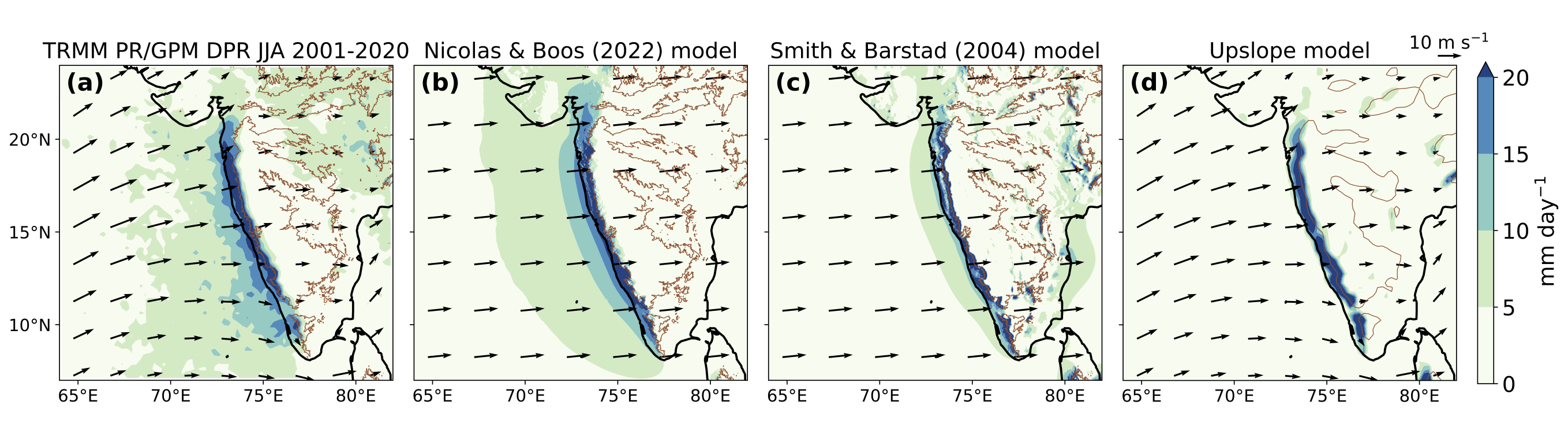
Precipitation distribution around the Western Ghats of India in observations (left), as given by our theory (middle left), and as given by two previous theories for orographic precipitation (right). From Nicolas and Boos, 2024.
Extreme weather events threaten human societies across the world, but are, by far, most
devastating in the tropics. While tropical rainfall extremes have been widely studied at the daily timescales, there has been
comparatively little work on seasonal-scale extremes. Are they caused by anomalously frequent wet days, or a few anomalously
extreme events? What are their climatological drivers? Are they associated with large changes in the frequency of certain
weather systems? My host group at ETH Zürich has tackled these questions over the past six years, with a focus on midlatitudes.
I joined the group to address these questions in tropical regions.
One approach to understanding these is a plume buoyancy framework. Tropical extreme seasons, both wet and dry, are relatively well
characterized by a simple measure of convective plume buoyancy. This measure only depends on seasonal-mean temperature
and moisture in the boundary layer and lower free troposphere. Understanding what leads to seasonal extremes in these
thermodynamic quantities (processes associated with surface fluxes, horizontal moisture advection, and others) may be easier than
understanding directly what leads to rainfall extremes.
Extreme heat events have been increasing in intensity over the past decades, with some heatwaves shattering previous temperature records by more than 5°C. How much can we expect them to intensify in the near future? A recent study (Zhang and Boos, 2023) suggested that there is a physical upper limit to surface temperatures, set by moist convective instability. The bound they proposed has the unexpected property of allowing for temperature profiles that are unstable to dry convection. Our paper (Nicolas and Hotz, 2026) investigates the reasons behind this behavior, and the characteristics of heatwaves that do feature such instability.
Superrotation is a strange feature of some planetary atmospheres, whereby the equatorial atmosphere rotates faster than the underlying planet. It is observed in the atmospheres of several planetary bodies in the Solar system (Venus, Jupiter, Saturn, Titan) and is expected to occur on many exoplanets. The mechanisms responsible for superrotation are still debated and vary depending on a planet's characteristics. Our paper (Nicolas and Vallis, 2026) investigates the mechanisms responsible for superrotation in shallow atmospheres in a simple two-layer model.
Understanding the dynamics of Earth's atmosphere requires a range of models of varying complexity, from pen-and-paper theories to complex general circulation models. Stationary wave models are an intermediate class of models designed to investigate the response of the atmosphere to steady forcings, such as topography or diabatic heating. One example of a question that a stationary wave models can help answer is whether mountains or diabatic heating are more important in shaping the mean position of the jet stream. I have implemented a stationary wave model using Dedalus, a python framework for solving PDEs. The model is freely available on Github.
EGU general assembly 2026 (Vienna, Austria),
Sorbonne Université (Paris, France), June 2026,
Land-Climate Workshop (St Andrews, Scotland), June 2026
EGU general assembly 2025 (Vienna, Austria)
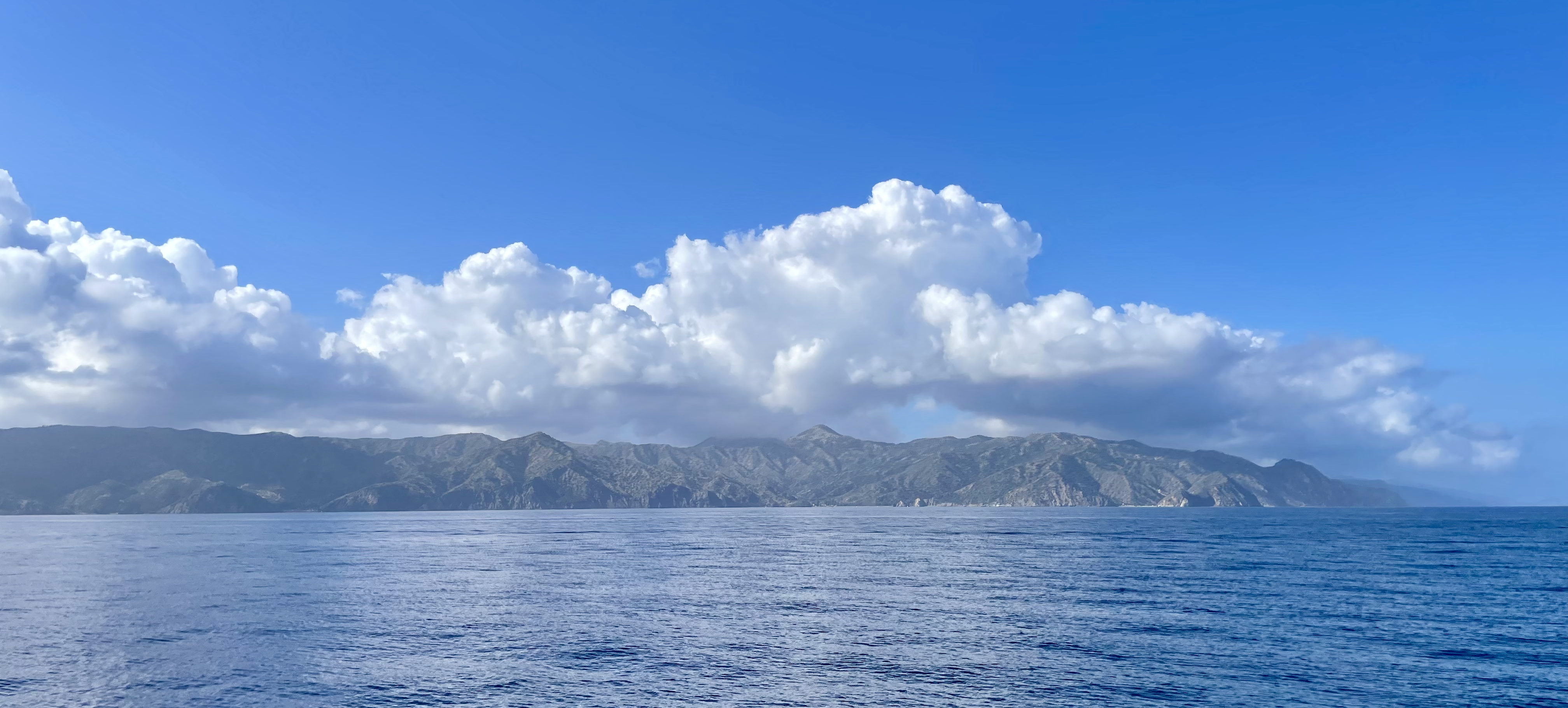
Nice orographic cumuli (presumably forced by the background southwesterly wind) over Catalina island in November 2023